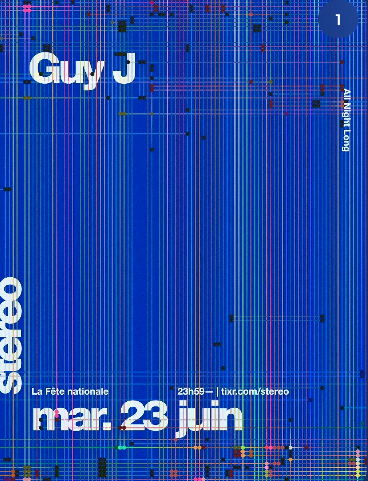
The following text is not a simple account of Guy J's performance at Stereo, and this is a preliminary version that I had to rush to post here for time-related reasons.
Throughout the night, several observations arose spontaneously and quickly went beyond the framework of the music itself. This experience led to a much broader reflection on the mechanisms that make certain nights so deeply memorable and on the connections that seem to exist between music, light, movement, the brain, and the human experience.
The goal of this text is first to bear witness to what was lived at the heart of Stereo that night. It then proposes a reflection on the mechanisms by which music, bass, rhythms, lights and the entire sensory environment seem to act simultaneously on our brain, our body and our state of consciousness.
Finally, this night also gave birth to a much more personal reflection on healing, the role of a deeply safe environment, the kindness of a community, and the way in which dancing can sometimes offer a mental space momentarily freed from threat, allowing the brain to find, if only for a few hours, a form of peace.
The sensory mechanicsDuring this night, a reflection imposed itself on me with uncommon force.
For years, I have observed dancers, DJs, lights, audience reactions and the immense variations in energy that flow through a room over the course of a performance. I have often spoken about it intuitively, but that night, I had the feeling of better understanding what happens when all these elements come together in perfect alignment.
I am not trying to explain this phenomenon scientifically. I am simply trying to put words to an experience I have been observing for a very long time. While pursuing my research after this night, I was surprised to find that several of these observations seem to align with recent work in neuroscience.
The first element is probably the music itself.
As the DJ builds his musical story, he progressively puts the dancer under tension. The breaks, the buildups, the loops, the filters, the frequency shifts and the long transitions create an anticipation that becomes almost physical. The dancer senses that something is happening. He does not always know exactly what, but his entire body already seems to be preparing for it.
I had written something similar just days before, but that night gave me what amounted to a nearly perfect demonstration.
A dancer is like a wind-up toy. You wind the springs, you put them under tension, you make them wait for the explosion during the breaks and the buildups, then you abruptly release that tension when the drop comes back.
The more intelligently constructed the music, the further in advance it announces the structure that is coming. The brain continuously receives small rhythmic, harmonic or sonic cues that unconsciously prepare the dancer for what is approaching. This is probably the art of the very greatest DJs: they do not merely surprise their audience, they prepare them.
Neuroscience today speaks of "predictive processing." Several researchers describe the brain as a system that continuously attempts to anticipate upcoming events. In the musical domain, this anticipation is thought to be an integral part of the pleasure felt during listening. What matters, then, is not only the resolution, but also everything that precedes it. This scientific literature obviously does not describe Guy J's techniques, but it sheds particularly interesting light on the mechanisms of anticipation that dancers experience. The work of Zatorre, Salimpoor and their collaborators clearly points in this direction.
This is exactly what fascinated me that night. I did not have the impression that he was simply playing tracks. I had the impression that he was continuously building states of tension, suspension and release.
Then there were the lights.
The incredible spectrum of deep blues, ultraviolets, turquoises and indigos seemed perfectly fused with the music. I wondered more than once whether this impression was merely an illusion.
Continuing my reading, I discovered that several studies suggest that different wavelengths of light do indeed influence our physiological state. Without being able to attribute a precise emotion to a single colour, research nevertheless shows that certain light environments can favor states of alertness, relaxation, concentration or contemplation depending on the context.
In other words, light is not simply decorative. It too participates in the sensory experience.
When music, bass, movement, light and the human environment converge in the same direction, they seem to form a whole far greater than the sum of their parts. This is precisely what I felt I was living through that night.
I no longer believe that we dance simply to music. We dance inside a complete sensory environment where sound, bass, lights, other dancers and our own movement all participate together in one and the same experience. Our brain then attempts to organize all this information into a coherent whole.
Several works also show that rhythm simultaneously engages the auditory, motor and temporal systems of the brain. Movement then becomes far more than a simple voluntary response: it is a genuine synchronization between music and body.
Reading this research after that exceptional night, I had the very strange feeling that several scientists were describing, in their own words, part of what I have been observing for years on a dance floor.
HealingIf there is one thing that night made me deeply realize, it is ultimately not how great a DJ Guy J is. That, I already knew. Nor is it how extraordinary Stereo is as a venue. I knew that too.
The true revelation of that night may concern more what music, dancing and a kind community allow a human being to rediscover when he is going through an extremely difficult period.
Just a few weeks ago, I was confronted with an event that reactivated a trauma I believed was behind me. I sincerely thought I had moved past that stage. Yet it only took one trigger for everything to come back with a violence I had not anticipated.
This experience reminded me of an important reality. One can learn to live with a trauma. One can become less fragile. One can end up believing that everything is settled. But that does not necessarily mean that everything is completely healed.
This is precisely what that night made me understand.
I realized that all the hundreds of nights spent dancing over the past several years have probably never served solely to entertain me. They may have participated, they too, in my rebuilding.
I have tapped thousands of steps.
I have spent hundreds of nights at Stereo.
I had my community.
I had a place to come back to.
I had deeply kind people around me.
Looking back, I think all of that played a far more important role than I had imagined.
Dancing that night, an idea took hold of me.
When a person lives through a significant trauma, part of their brain seems to remain constantly occupied with surveying the environment. It searches for threats, anticipates danger and stays on alert far more often than one realizes.
Yet, on a floor like that of Stereo, something very particular seems to occur.
Rhythm mobilizes our attention.
Bass constantly solicits the body.
Movement demands constant coordination.
Lights occupy the gaze.
The other dancers become part of our perception.
Music continuously builds new expectations.
For several hours, almost all our attention is captured by this sensory experience.
I then had the impression that the brain momentarily stopped devoting all its energy to seeking out danger.
A space became available.
I do not yet know how to describe this phenomenon exactly, but it is probably the most important observation this night offered me.
Dancing gives me the impression of accessing, for a period of time, a protected mental space where traumatic intrusions momentarily cease to occupy all the room.
This is exactly the image that came to me.
Part of our brain has been shattered by trauma.
Dancing might perhaps begin to progressively reattach those fragments.
The act of tapping the beat, of stomping a foot and of submitting the body to movement progressively transforms mental impulses into physical impulses. The body then becomes the immediate expression of the music. All of that energy finally finds a place to be expressed.
I consider myself immensely privileged.
I have received an enormous amount of love.
An enormous amount of support.
I felt welcomed, protected and surrounded by a deeply kind community. I am convinced that this human dimension is an integral part of my rebuilding.
Unfortunately, not everyone has this chance.
I often think of those who go through similar trials without benefiting from an environment that is safe enough to set down, even for a few hours, the weight they carry daily.
Continuing my reading after that night, I discovered that several works in neuroscience show that music simultaneously mobilizes the attentional, motor and emotional systems. Other research suggests that rhythmic movement may contribute to momentarily diverting attention from certain internal processes and foster better emotional regulation.
I remain, however, very cautious.
This research does not demonstrate what I have just observed and certainly does not allow one to claim that dancing heals trauma.
Nevertheless, it points in a direction that resonates deeply with me and that deserves, in my view, to be further explored.
What I report here remains above all a personal observation, born of a lived experience. If it one day finds a broader echo in the scientific literature, I will obviously be pleased. But, even without that, this night has deeply convinced me of one thing: music, dancing, kindness and the sense of safety can sometimes offer a human being a space where it finally becomes possible to breathe a little more freely.
ConclusionIn the end, this text never had as its goal to prove anything.
It was born from a night where several observations presented themselves almost simultaneously, as if all the pieces of an immense puzzle had momentarily decided to align.
Some of these observations may one day find more complete answers in neuroscience. Others will probably remain intuitions, hypotheses or simply deeply human experiences. And that is perfectly fine.
What I retain above all from that night is the immense privilege of having been able to live all of that in a place like Stereo.
I measure today the luck I have had.
The luck of having found, over all these years, a place to come back and dance.
The luck of having been welcomed by a deeply kind community.
The luck of having been able to lose myself in the music when I needed it most.
The luck of having met thousands of people who, often without even knowing it, have probably also participated in my rebuilding.
People often say that music heals.
For a long time, I found that phrase beautiful.
Today, I believe above all that it deserves to be explored.
Not as a romantic formula.
Not as an absolute truth.
But as a genuine question.
What actually happens when a human being finds himself immersed for several hours in an environment where music, light, movement, trust, kindness and the sense of belonging to a group all seem to act simultaneously?
I obviously do not have the answer.
But I am convinced that this question deserves to be asked.
And if this text can contribute, even a little, to opening this reflection, then that night will have left a trace that goes far beyond the memory of an immense musical performance.
Thank you to Guy J for this true demonstration of mastery.
Thank you to Stereo for continuing to make exist a place where such experiences remain possible.
Thank you to all the dancers.
You are much more than the audience.
You are an essential part of the work.
Without you, there is neither energy, nor abandon, nor synchrony, nor that strange magic that sometimes transforms a simple night of music into a deeply human experience.
On June 23, 2026, I had the feeling that all the conditions were in place.
And if the first phrase that came to me as I left the room was that Stereo had received the last rites, it was perhaps simply because I had not found a better word to describe a night where, for a few hours, everything seemed exactly in its place.